USS Abraham Lincoln deployment has become a central focus of global attention as the United States significantly escalates its military presence in the Middle East amid rising tensions with Iran. The move signals a heightened security posture by Washington as unrest inside Iran and sharp rhetoric from President Donald Trump fuel fears of regional escalation.
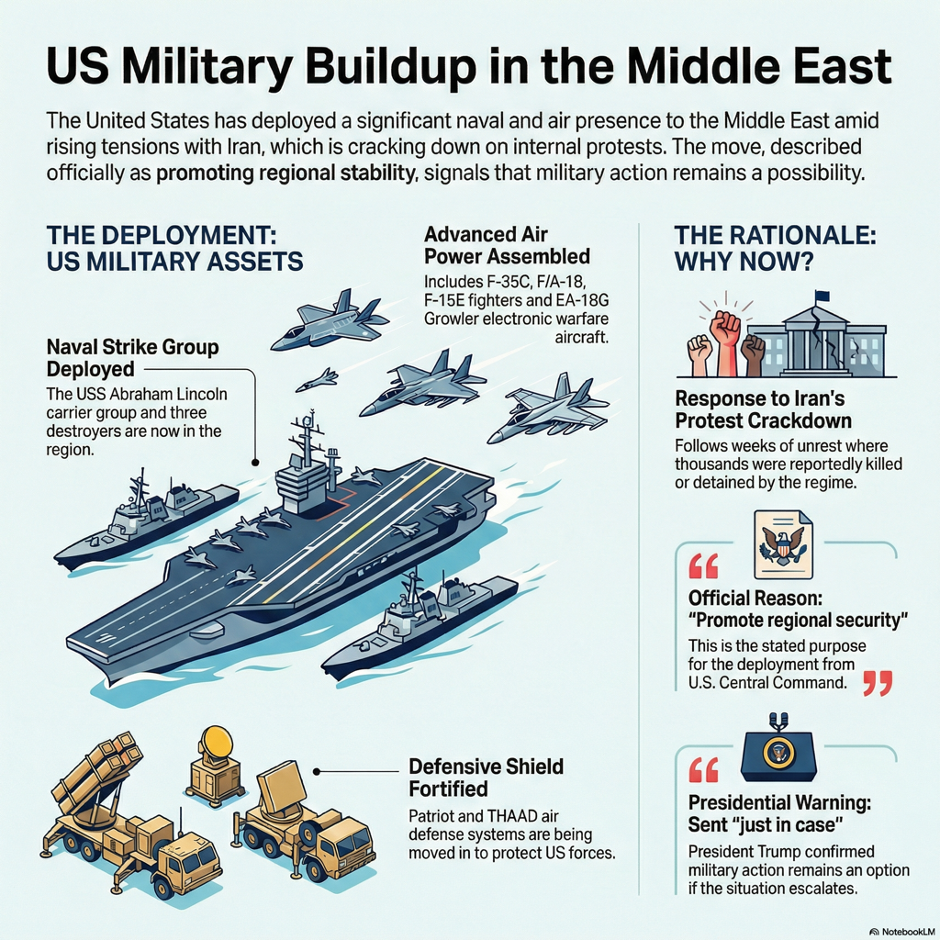
The US Central Command confirmed that the USS Abraham Lincoln aircraft carrier strike group is currently operating in the Indian Ocean, marking the end of a months-long absence of US aircraft carriers in the region. Officials stated that the deployment is intended to “promote regional security and stability,” though its timing has amplified concerns about potential military confrontation.
USS Abraham Lincoln Deployment and Strategic Context
The USS Abraham Lincoln deployment follows weeks of internal unrest in Iran, where widespread protests have been met with a severe government crackdown. Human rights groups estimate thousands of casualties and mass detentions, prompting strong warnings from Washington.
President Trump has publicly acknowledged the military buildup, stating the carrier group was sent “just in case,” while emphasizing that military action remains an option. At the same time, he has offered conflicting signals, alternating between threats of overwhelming force and claims that Iran has paused executions of detained protesters.
Military Assets and Capabilities in the Region
Defense officials say the current deployment significantly enhances US offensive and defensive capabilities. Alongside the aircraft carrier, US Navy destroyers capable of launching cruise missiles have been positioned in the region.
The strike group carries F-35C and F/A-18 fighter jets, supported by EA-18G Growler aircraft for electronic warfare. Additional F-15E Strike Eagle jets, military cargo aircraft, and advanced air defense systems — including Patriot and THAAD batteries — have also been moved into place to protect US forces and allies.
Historical Parallels and Regional Risk
Analysts note that the USS Abraham Lincoln deployment closely mirrors force buildups seen in the previous year, which preceded direct military exchanges between the US and Iran. Following earlier US strikes on Iranian nuclear facilities, Tehran responded with missile attacks on US-linked bases in the region.
This historical precedent has raised concerns that the current posture could increase the risk of miscalculation, even as officials maintain that deterrence — not escalation — is the primary objective.
Why the Buildup Matters
The military escalation highlights a broader strategy in which Washington uses visible force projection to influence regional behavior. As Iran tensions in 2026 continue to evolve, global markets, US allies, and regional powers are closely watching whether diplomacy or confrontation defines the next phase.